
Home >Pharmaceutical > 1,3,5-Tris(2-hydroxyethyl)cyanuric acid
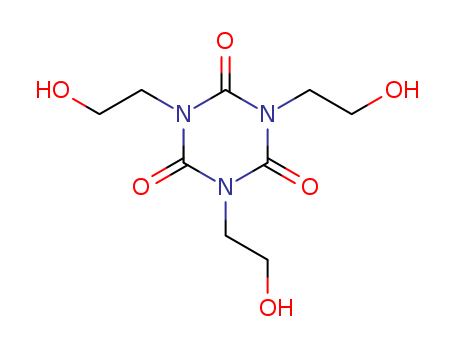
- Chemical Name: 1,3,5-Tris(2-hydroxyethyl)cyanuric acid
- CAS No.: 839-90-7
Purity 99% Min 1,3,5-Tris(2-hydroxyethyl)cyanuric acid 839-90-7 Spot Supply with Safe Transportation
- Molecular Formula: C9H15N3O6
- Molecular Weight: 261.235
- Appearance/Colour: white powder
- Vapor Pressure: 0.001Pa at 50℃
- Melting Point: 136-140 °C
- Boiling Point: 526.7 °C at 760 mmHg
- PKA: 14.03±0.10(Predicted)
- Flash Point: 272.3 °C
- PSA: 126.69000
- Density: 1.498 g/cm3
- LogP: -3.85140
1,3,5-Tris(2-hydroxyethyl)cyanuric acid(Cas 839-90-7) Usage
|
Synthesis Reference(s) |
The Journal of Organic Chemistry, 28, p. 85, 1963 DOI: 10.1021/jo01036a019 |
|
Air & Water Reactions |
Water soluble. |
|
Reactivity Profile |
An organo-isocyanate. Isocyanates and thioisocyanates are incompatible with many classes of compounds, reacting exothermically to release toxic gases. Reactions with amines, aldehydes, alcohols, alkali metals, ketones, mercaptans, strong oxidizers, hydrides, phenols, and peroxides can cause vigorous releases of heat. Acids and bases initiate polymerization reactions in these materials. Some isocyanates react with water to form amines and liberate carbon dioxide. |
|
Fire Hazard |
Flash point data for 1,3,5-Tris(2-hydroxyethyl)cyanuric acid are not available, but 1,3,5-Tris(2-hydroxyethyl)cyanuric acid is probably combustible. |
|
Flammability and Explosibility |
Notclassified |
|
General Description |
1,3,5-Tris(2-hydroxyethyl)cyanuric acid (THEIC) is a versatile compound used as a charring agent and modifier in flame-retardant systems. When incorporated into melamine-formaldehyde resin (MFT), it enhances the resin's flexibility, cohesiveness, and flame-retardant efficiency by promoting char formation during combustion. Its hydroxyl groups contribute to improved thermal stability and compatibility with polymers like polypropylene, making it valuable in intumescent flame-retardant applications. Additionally, THEIC synergizes with ammonium polyphosphate (APP) to form a protective char layer, enhancing flame retardancy and water resistance in polymer composites. |
InChI:InChI=1/C9H16N3O6/c13-4-1-7-8(16)10(2-5-14)12(18)11(3-6-15)9(7)17/h7,13-15H,1-6H2
839-90-7 Relevant articles
Preparation method of theic
-
Paragraph 0041-0067, (2021/02/10)
The invention relates to the field of or...
Piperidyl organosiloxanes and polymer substrates light-stabilized therewith
-
, (2008/06/13)
Novel piperidyl organosiloxanes, well ad...
Application of the study of reactivity of alkaline salts of isocyanuric acid to the synthesis of mono and trisubstituted isocyanurates
Chiron-Charrier,Caubere
, p. 2659 - 2672 (2007/10/02)
Reactivity of alkaline salts of isocyanu...
839-90-7 Process route
-
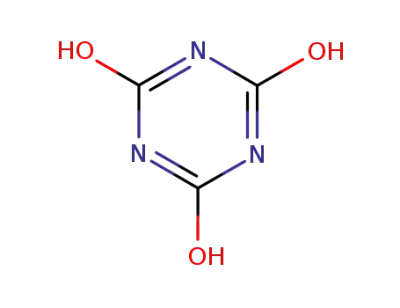
-
108-80-5
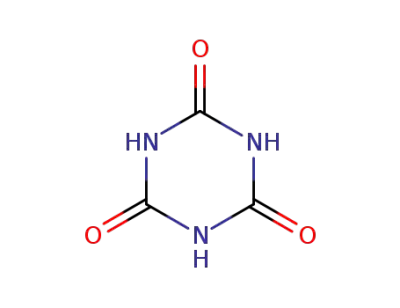
isocyanuric acid

-
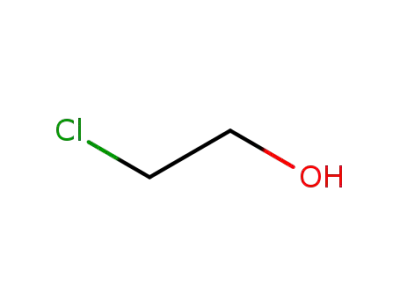
-
107-07-3
2-chloro-ethanol

-
-
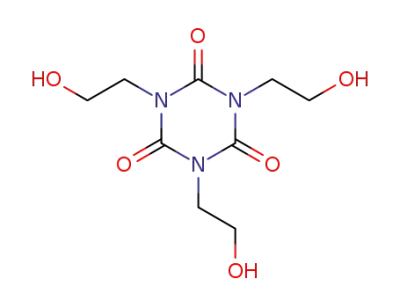
839-90-7
1,3,5-tris(2-hydroxyethyl)-S-triazine-2,4,6-trione
| Conditions | Yield |
|---|---|
|
With
triethylamine;
In
N,N-dimethyl-formamide;
at 80 - 85 ℃;
Reagent/catalyst;
Temperature;
Solvent;
|
271.6 g
|
-
-
108-80-5,27026-93-3,27941-25-9
cyanuric acid
-
-
107-07-3
2-chloro-ethanol
-
-
839-90-7
1,3,5-tris(2-hydroxyethyl)-S-triazine-2,4,6-trione
| Conditions | Yield |
|---|---|
|
With
sodium hydride;
Yield given. Multistep reaction;
1.) HMPA, 100 deg C, 3 h, 2.) HMPA, 100 deg C, 7 h;
|
839-90-7 Upstream products
-
108-80-5
cyanuric acid
-
107-07-3
2-chloro-ethanol
-
108-80-5
isocyanuric acid
839-90-7 Downstream products
-
130839-94-0
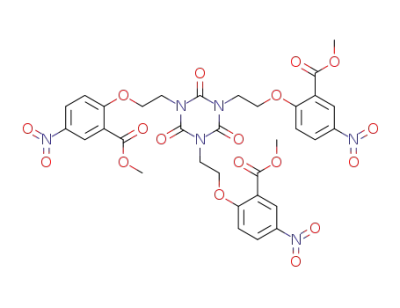
C33 H30 N6 O18
-
6299-37-2
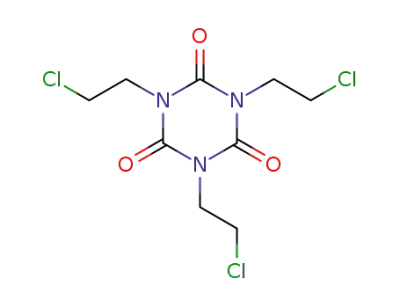
1,3,5-tri(2-chloroethyl)-1,3,5-triazine-2,4,6-trione
-
951016-94-7
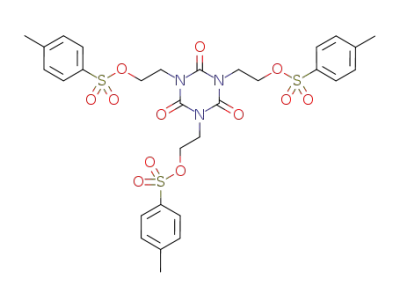
1,3,5-tris(2-tosylethyl)-1,3,5-triazine-2,4,6-trione
-
130839-93-9
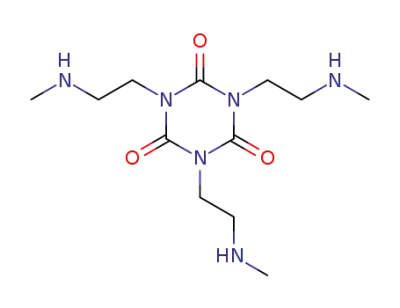
1,3,5-Tris-(2-methylamino-ethyl)-[1,3,5]triazinane-2,4,6-trione